Using Wireless Sensors for Condition Monitoring
Wireless Sensors for Condition Monitoring or Asset Health Management is a hot topic. It’s helping companies to get the most from their assets, by minimising downtime, maximising asset availability and reducing costs. For example, the cost of downtime is highlighted with the example of a soft drinks manufacturing plant – the conveyor belt went down for only 15 minutes but the lost production cost the company a huge amount.
The Importance of Wireless Condition Monitoring
It’s important for companies to have a good condition monitoring system. It improves the use of assets, prevents incidents or detects them sooner. It also means that less operator time is spent monitoring the proper functioning of systems as the condition monitoring system is taking care of it. You can read more about the benefits of conditioning monitoring on our blog.
In today’s commercial world, people are getting used to sensors such as Apple Watch, Smartphones, etc. monitoring things continuously and in real-time, but be aware that this continuous, real-time monitoring is not required for condition monitoring and costs A LOT!
Understanding the difference between the data requirements for condition monitoring and data acquisition or process control is important and will save your company time and money. The main difference – Smart watches have their sensors running continuously which is not a requirement for condition monitoring. Below you can read in more detail what the difference is between the two.
How to properly use wireless sensors for condition monitoring
With condition monitoring, it’s not about quantity, but more about the quality of the data.
- You don’t need real-time measurement generating huge amounts of data always telling you everything.
- You do need the relevant, vital information instead of every single detail.
- You want to know when your machinery is close to breaking down, or needs maintenance, so that you can assess how long it can still be used safely, before repairing it.
At Sensor-Works we set up condition monitoring systems with intuitive sensors that collect the important data, allowing you to save on maintenance costs. By using wireless conditioning monitoring sensors correctly, there won’t be a constantly flow of data coming in, but instead, meaningful information, only when it is required, in the form of simple to interpret graphics.
Having sensors downloading and uploading data to the cloud is expensive. This means that thousands of pounds can be wasted on storage and collection of data alone. And you’re spending all that money only to be left with too much data that you may or may not need.
For a condition monitoring application, there’s no need for your sensors to be continuously collecting data, every second of every day. Sensor-Work’s sensors only collect data when it’s really required, without losing the valuable information necessary for an effective condition monitoring solution. The amount of data collected, processed and sent to the cloud is optimised, to give the most effective solution with the minimum of data and minimum running costs.
How can Sensor-Works help?
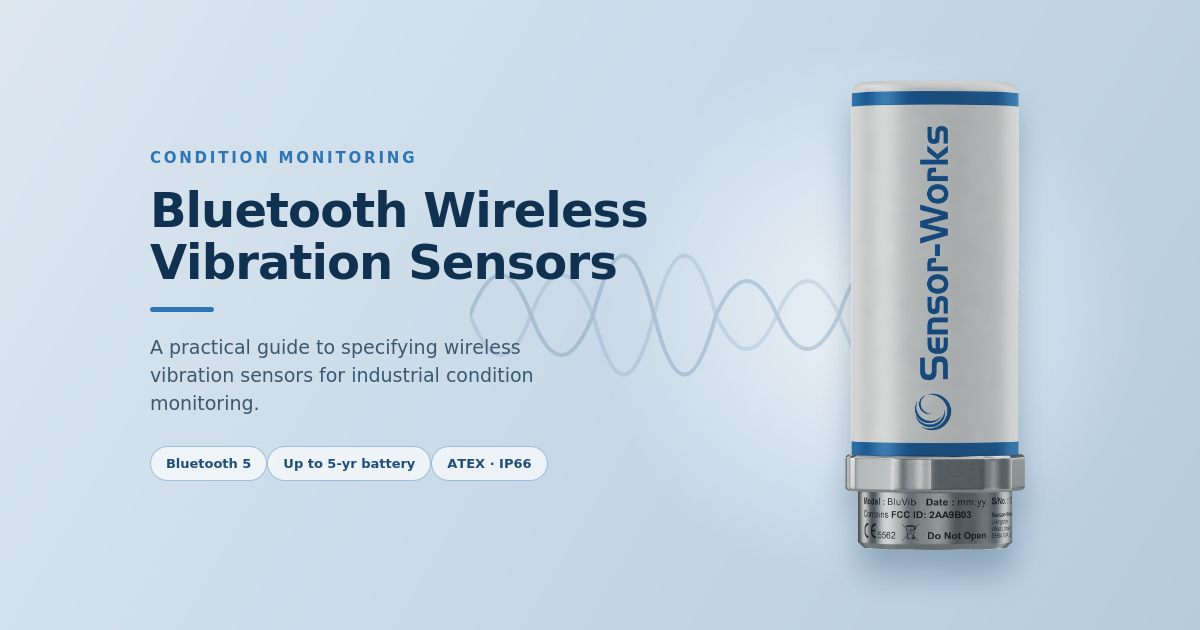
Sensor-Works has put together cutting-edge technology to produce a monitoring package that is “low cost, quick to install and easy to use.” Using unique technology to make it wireless, BluVib uses the latest Bluetooth 5 wireless protocol, which means it has an extended range and battery life.
The sensors communicate with any Bluetooth compatible device as well as being able to communicate and interface with BluTrend. BluTrend is a software package that provides the essential functionality of a real-time monitoring system and includes comprehensive analytical capabilities.
Sensor-Works helps with the overall reliability management strategy to ensure maximum efficiency and availability of equipment. Sensor-Works can apply knowledge and skill into a wide spectrum of applications from oil and gas to green energy for both domestic and international markets. Contact us to see how we can help you.