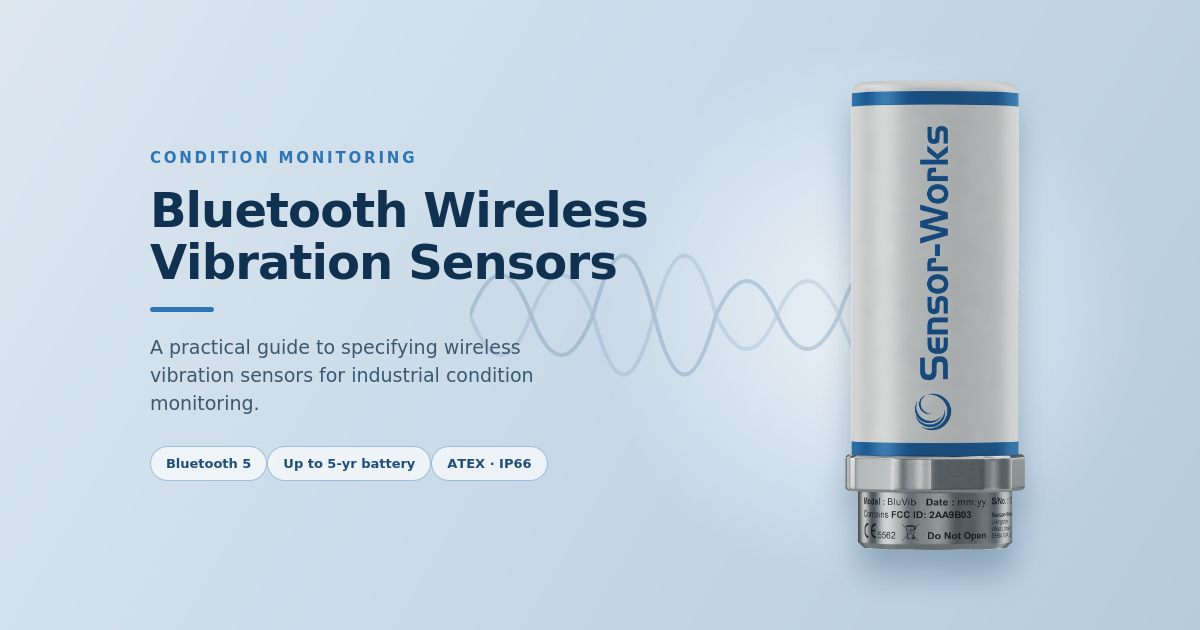

What is a Bluetooth wireless vibration sensor?
A Bluetooth wireless vibration sensor is a battery-powered industrial sensor that measures vibration and temperature mainly on rotating machinery (motors, pumps, gearboxes, fans) and transmits the data wirelessly using the Bluetooth Low Energy standard. It runs unattended for several years on a single field-replaceable battery, requires no signal cabling, and connects directly to a smartphone, tablet, or fixed gateway, router or industrial PC. It is one of the most cost-effective ways to extend condition monitoring beyond the small number of critical assets that justify wired systems.
This guide explains how Bluetooth vibration sensors work, when they make sense, what to look for when specifying one, and how Bluetooth compares with the main alternative wireless protocols (WirelessHART, LoRaWAN, Wi-Fi).
Why does this matter? The cost of unmonitored machinery
Unplanned downtime is now the dominant cost most manufacturers fail to track properly. According to the Siemens True Cost of Downtime report (2024), the world’s 500 largest companies lose approximately $1.4 trillion every year to unplanned downtime, equivalent to 11% of total revenues, up from 8% just five years earlier. ABB’s Value of Reliability survey of 3,200 plant maintenance leaders found that two-thirds of plants experience unplanned downtime at least once a month, at an average cost of $125,000 per hour.
Most of those failures originate in the same few places. Equipment failure causes roughly 42% of unplanned downtime, and bearings, seals, motors, and drives are the usual suspects. Vibration is the earliest detectable warning sign for nearly all of them.
The reason wireless vibration sensors matter is straightforward. Continuous monitoring used to be too expensive to justify on anything but the most critical machine in a plant. Wireless changes the economics. Bluetooth-based sensors in particular are now cheap enough, simple enough, and energy-efficient enough that monitoring hundreds of assets becomes practical instead of monitoring only a few.
How Bluetooth wireless vibration sensors work
A Bluetooth wireless vibration sensor packs five things into a small ruggedised housing, typically around 33 mm in diameter and 92 mm tall:
- An accelerometer (either piezoelectric or MEMS) that converts mechanical vibration into an electrical signal.
- A microcontroller that samples the signals and sends the raw acceleration time spectrum and temperature to the paired device via the Bluetooth radio.
- A long-life battery, typically a lithium thionyl chloride AA cell.
- A mechanical mount, usually a ¼-28 UNF threaded base for stud or magnetic mounting.
The sensor sleeps almost all the time. In a typical condition-monitoring deployment it wakes between 1 to 4 times a day, takes a measurement, transmits the result to a gateway or a phone, and goes back to sleep. That sleep-mostly behaviour is what allows a single AA-sized cell to power the device for up to 5 years without intervention.
The data flows in one of two ways. Either to a fixed gateway running continuously, which forwards the data to your own monitoring platform on a gateway/router via a ReST API/Sensor Link, or directly to a smartphone or tablet that an engineer carries on a walk-around inspection. The same sensor can do both.
Why Bluetooth 5, specifically?
Bluetooth has been around since 1999, but the version that matters for industrial condition monitoring is Bluetooth 5 Low Energy, adopted by the Bluetooth SIG in December 2016. Compared with the earlier Bluetooth 4.x Low Energy standard, Bluetooth 5 delivers:
- Up to 4× the range (via the new Coded PHY mode, which trades data rate for sensitivity)
- Up to 2× the throughput (via the optional 2 Mbps PHY)
- 8× the broadcast capacity
- Backwards compatibility with Bluetooth 4.2 devices
For condition monitoring, those numbers translate to four practical advantages over alternative protocols.
Power efficiency. Bluetooth Low Energy is engineered for devices that spend most of their life asleep. A well-designed Bluetooth 5 sensor in scheduled-wakeup mode draws very low standby current when idle, which is what makes 5-year battery life on a single AA cell possible.
Universal client support. Every modern smartphone, tablet, and laptop has a Bluetooth radio. A maintenance engineer can configure or read a Bluetooth sensor with a phone they already carry, without a specialist gateway or PLC. This is a meaningful difference compared with WirelessHART, LoRaWAN, or proprietary radio standards, all of which need dedicated infrastructure and (usually) dedicated training.
Frequency-hopping resilience. Bluetooth 5 hops across 40 channels in the 2.4 GHz band, which makes it robust against interference from drives, motors, and other RF noise in industrial environments.
Security. Bluetooth Low Energy supports AES-128 encryption and authenticated pairing as standard. For condition monitoring data (operationally sensitive but not personally identifiable), this is generally sufficient when combined with normal IT practice on the gateway side.
Bluetooth vs the alternatives
If you’re choosing a wireless protocol for industrial vibration monitoring today, the honest comparison looks like this:
| Feature | Bluetooth 5 LE | WirelessHART | LoRaWAN | Wi-Fi |
|---|---|---|---|---|
| Typical industrial range | 30–100 m | 200 m mesh | 2–10 km | 30–50 m |
| Throughput | Up to 2 Mbps | 250 kbps | 0.3–50 kbps | 10–100+ Mbps |
| Battery life (typical) | Up to 5 years | 3–10 years | 5–10 years | Days to weeks |
| Smartphone client | Yes | No | No | Yes |
| Mesh self-healing | Possible, but not the standard (usually point-to-point) | Yes | No | No |
| Setup complexity | Low | High | Medium | Medium |
| Best fit | Walk-around plus small/medium plant continuous monitoring | Large process plants, existing HART infrastructure | Outdoor or dispersed assets | High-bandwidth streaming, Wi-Fi-blanket facilities |
Bluetooth wins decisively where setup simplicity, battery life, and smartphone-compatibility matter, which covers the majority of condition-monitoring deployments outside the very largest process plants.
What to look for when specifying a Bluetooth vibration sensor
The headline “Bluetooth vibration sensor” hides a lot of variation in what the device actually measures and how well. The points below matter more than the radio.
1. Frequency range
The frequency range of the accelerometer determines what kinds of faults you can detect. Bearing defects show up at high frequencies; structural and rotational issues show up at low ones.
- MEMS accelerometers typically measure from DC up to around 6 kHz for trending and 10 kHz for spectral analysis. The DC capability is useful, allowing detection of tilt, settlement, or static orientation that pure-AC sensors miss. Also ideal for very low-speed machines; this, coupled with large internal memory of 2,097,152 data samples, allows for many revolutions of a very slow rotating asset, allowing averaging and deeper analytic capabilities.
- Piezoelectric accelerometers typically start higher (5 Hz upwards) and extend to 10 kHz cleanly. Some piezo sensors, including the BluVib P1, go as low as 0.3 Hz, which makes them suitable for slow-running assets like cooling tower fans, paper machine rolls, and large agitators where most piezo competitors lose useful signal.
If your asset population includes very low-speed machinery, frequency floor matters more than top-end resolution.
2. Number of axes
Single-axis sensors are cheaper, simpler, and longer-lived. They’re appropriate where you know in advance which direction the dominant fault signature will appear, typically vertical or horizontal at the bearing.
Triaxial sensors capture X, Y, and Z simultaneously and give a more complete picture. They’re usually the right choice for unfamiliar assets, semi-critical machines, or anywhere you want to detect misalignment alongside imbalance.
3. Amplitude range
A range of ±16 g to ±25 g covers nearly all rotating-machinery applications. Programmable ranges (e.g. ±2 g, ±4 g, ±8 g, ±16 g) let you trade dynamic range against resolution depending on what you’re measuring.
For very high-shock environments (reciprocating compressors, hammer mills, presses), you may need higher-range sensors that go beyond what most general-purpose Bluetooth sensors offer.
4. Sample rate and spectral resolution
Useful headline numbers to look for:
- Sample rate: 25.6 kHz is a sensible benchmark for general-purpose use.
- Spectral lines: 12,800 lines of resolution is enough to separate close fault frequencies (such as bearing defect frequencies in slow-running machines). The sensor is capable of going to 8,192k lines.
- Block length: 32,768 samples give long enough captures for low-frequency content; again, the sensor is capable of going to 2,097,152 samples, useful for rundown analysis, or pipe/structural resonance.
If a vendor doesn’t publish these numbers, the sensor probably only supports overall vibration trending, not genuine spectral analysis.
5. Mounting
Vibration measurement quality is dominated by how well the sensor is mechanically coupled to the asset. From best to worst:
- Stud mount (e.g. ¼-28 UNF threaded into the casing). Best signal transfer, recommended for permanent installation.
- Adhesive. Good for permanent installation where drilling and tapping isn’t practical.
- Magnetic. Good for temporary or walk-around use; use a split-face magnet with at least 18 kg pull strength.
- Stinger. Only when nothing else works on non-magnetic materials. Keep it as short as possible.
A capable Bluetooth sensor should support at least the first three options out of the box. For more on sensor placement, see our guide on beginning your condition monitoring journey, which covers the full mounting hierarchy.
6. Hazardous-area certification
If the sensor will be deployed in oil, gas, chemical, or other potentially explosive atmospheres, you need an ATEX (Europe), IECEx (international), or UKEX (UK) certified intrinsically safe variant. The relevant marking for typical Zone 0 use is Ex ia IIC T4 Ga.

The sensors are also available for dust environments:
ATEX variant II 1G Ex ia IIC T4 Ga –25ºC to +75ºC, Dust Certified Ex ia IIIB T200 170ºC Da.
Verify both the sensor body and the battery type are certified. Battery substitution can void the certification. Hazardous-area variants typically use a SAFT LS14500 cell rather than the standard LS17500.
7. Battery life and replaceability
Modern wireless sensors should comfortably reach 5 years of unattended operation in scheduled-wakeup mode (typically four measurements per day). The battery should be field-replaceable, since sealed-for-life designs become e-waste once depleted.
A lithium thionyl chloride AA cell (e.g. SAFT LS17500 for standard use, LS14500 for ATEX) is the de facto industry standard.
8. Operating modes
A flexible Bluetooth sensor will offer at least four programmable modes:
- Scheduled wakeup, with measurements at programmed intervals (best for battery life)
- Continuous or Ready, for setup, demonstration, or critical assets where intermittent monitoring isn’t enough
- Triggered, waking on threshold crossing, useful for capturing transient events
- Logging, storing velocity overall, temperature and battery data on-board for later download (useful for temporary on-line monitoring of a problematic remote asset that needs to be quickly monitored)
Programmable parameters should include sample rate, block length, wakeup interval, trigger level, and trigger delay.
Where Bluetooth makes sense, and where it doesn’t
Worth being honest about the limits.
Bluetooth is well-suited to:
- Walk-around inspections with a phone or tablet acting as the gateway
- Permanent monitoring within a single machine hall, packaged skid, or production line
- Brownfield deployments where running new cable would be prohibitively expensive
- Applications where a maintenance engineer needs to configure or interrogate sensors without IT involvement
- Hazardous areas where wired installation costs are amplified by certification requirements
Bluetooth is less well-suited to:
- Single sensors spread across a very large site without local gateways. Bluetooth’s range is generous but not unlimited. Large plants typically need a network of gateways, or a hybrid approach using LoRaWAN or cellular for the long-haul leg.
- Continuous high-bandwidth raw-waveform streaming to a central system. Bluetooth Low Energy’s strength is low-power short bursts, not constant high-throughput streaming. For these applications, a wired or Wi-Fi-based solution is more appropriate.
- Sites with strict no-RF policies (rare, but they exist).
For most industrial condition monitoring use cases (periodic measurement on rotating assets, with results trended over time), Bluetooth 5 is genuinely well-matched to the workload. Where it isn’t, hybrid setups with Bluetooth at the sensor and an Ethernet or cellular gateway-to-cloud link generally work better than choosing a single protocol for everything.
Common applications
Bluetooth wireless vibration sensors are most often deployed on these categories of rotating machinery:
- Electric motors, for bearing condition, imbalance, looseness, and the early stages of stator and rotor faults
- Centrifugal pumps, for cavitation, impeller damage, seal wear, and bearing degradation
- Gearboxes, for gear mesh frequencies, tooth damage, and shaft misalignment
- Fans and blowers, for imbalance, fouling, blade damage
- Generic two-bearing shaft arrangements, for any rotating component where you need a baseline
Standardised templates with ISO 20816 alarm thresholds (for motors, centrifugal pumps, gearboxes, and generic shafts) make it straightforward to deploy condition monitoring without bespoke configuration for each asset class. A typical practice is to set an alert at a 10% increase from baseline and an alarm at a 30% increase, refining the levels as the asset’s normal operating envelope becomes clearer.
If you’re starting from scratch, beginning with these templates and refining as you learn is far more practical than designing a custom alarm strategy on day one. The Sensor-Works Machine-Check tool ships with all four templates pre-configured for exactly this reason.
Frequently asked questions
Are Bluetooth vibration sensors secure enough for industrial use?
Bluetooth Low Energy 5 supports AES-128 encryption and authenticated pairing as standard. For condition monitoring data (sensor readings rather than personal data), this is generally sufficient when combined with normal IT practice on the gateway side. Sensitive deployments should also use a hardened gateway and segmented network for the upstream link.
How far does a Bluetooth vibration sensor transmit?
Practical industrial range is typically 30 to 100 metres depending on environment, sensor placement, and gateway position. Bluetooth 5 supports much longer theoretical ranges in the optional Coded PHY mode, but most industrial sensors prioritise reliable indoor coverage rather than maximum line-of-sight reach. For larger plants, multiple gateways are typically used.
How long does the battery actually last?
A well-designed sensor in scheduled-wakeup mode, taking four measurements per day, will typically run for around 5 years on a single lithium thionyl chloride AA cell. Continuous-mode operation reduces this dramatically, often to weeks or months, so wakeup mode is recommended wherever intermittent measurement is acceptable.
Can I use my phone as a gateway?
Yes. Most Bluetooth wireless vibration sensors include a configuration and read-out app, typically for Android devices. This is particularly useful for walk-around inspections and initial sensor commissioning. For continuous unattended monitoring you’ll want a dedicated gateway running 24/7.
Bluetooth, WirelessHART, or LoRaWAN: which should I choose?
Use the comparison table earlier in this article. As a rule of thumb: Bluetooth is best where setup simplicity, smartphone-class clients, and short-to-medium range matter most. WirelessHART suits large process plants with existing HART infrastructure. LoRaWAN is the right choice for very long range (kilometres) and very low data rates, typically large outdoor sites or geographically dispersed assets.
Are Bluetooth vibration sensors ATEX-certified?
The better products are. Look for Ex ia IIC T4 Ga marking under ATEX, IECEx, or UKEX. Always check that the certified battery type is fitted, since substituting a different cell can invalidate the certification.
What’s the difference between MEMS and piezoelectric Bluetooth sensors?
MEMS sensors measure from DC up to around 6 to 10 kHz, are smaller and slightly cheaper, and are well-suited to general-purpose monitoring of motors, pumps, and gearboxes. Piezoelectric sensors typically have a higher frequency floor (around 2 Hz) but stronger high-frequency response, and can be specified down to 0.3 Hz for slow-running assets. Many condition monitoring programmes use both: MEMS for the broader population, piezo for specific high-resolution or low-frequency cases.
Specifying the right Bluetooth sensor for your asset
If you’re evaluating Bluetooth wireless vibration sensors, the most useful next step is to match the sensor to the asset rather than start with the radio. Sensor-Works manufactures a range of Bluetooth 5 wireless vibration sensors covering single-axis piezo, triaxial piezo, and triaxial MEMS technology, with ATEX-certified variants available for hazardous areas:
- The BluVib P1 is a single-axis piezo sensor with a 0.3 Hz to 10 kHz frequency range, suitable for critical assets that need detailed analytical algorithms and detailed bearing analysis. ATEX variant available.
- The BluVib P3 is a triaxial piezo sensor with 2,097,152 samples of onboard data storage and programmable sensitivity (50, 100, 200, or 500 mV/g) for high-resolution applications.
- The BluVib M3 is a triaxial MEMS sensor with 2,097,152 samples of onboard data storage, programmable amplitude range (±2 g to ±16 g) and DC-to-10 kHz spectral capability, a good general-purpose choice for motors, pumps, and gearboxes. ATEX variant available.
- The Machine-Check bundles two MEMS sensors with a rugged Android handset and pre-configured ISO 20816 templates for walk-around inspections.
- The BluVib Field Trial or Lab Kit gives integrators a Raspberry Pi 5 gateway running a REST API for custom condition-monitoring builds.
If you’d like to discuss which sensor is best matched to a particular asset or application, get in touch. Happy to talk it through.
Sources and further reading
- Siemens, The True Cost of Downtime 2024
- ABB, Value of Reliability (2024), survey of 3,200 plant maintenance leaders
- Bluetooth SIG, Bluetooth Core Specification 5.0 (December 2016)
- ISO 20816, Mechanical vibration: Measurement and evaluation of machine vibration
- Begin your condition monitoring journey, by Jim Fowlie
- Wireless condition monitoring
- Predictive vs preventive maintenance