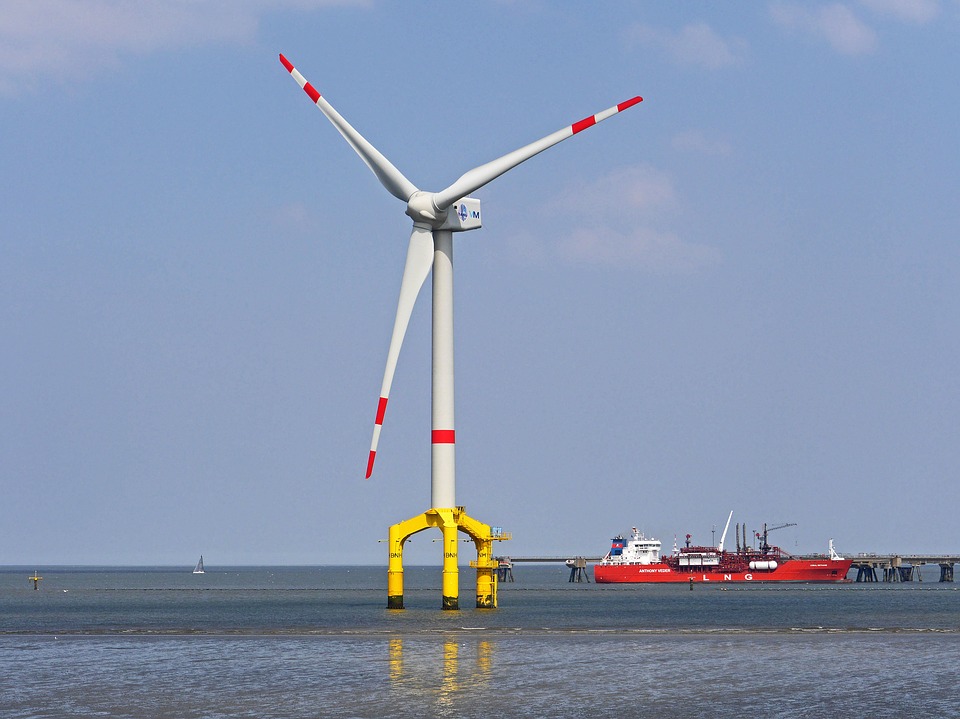

Recent development in green energy have led to the creation of some of the most incredible looking structures in the North Sea. Yes, we’re talking about the wind turbines between Scotland and Norway, and if you haven’t seen them, you’re missing out. They seem to jet out of the ocean like massive monolithic creatures of the deep. Their rhythmically moving turbines contrast starkly with the slowly moving ripples of the waves. Strangely enough, these enormous machines don’t even look the slightest bit out of place, as if they’ve been standing there for years. For some more footage of how truly awesome these massive turbines can look, check out this video from Tech Insider:

The future is floating
The principle behind this innovation is that the turbines will be able to benefit from the higher wind speeds at sea. It’s also easier to build a dense concentration of wind turbines in the sea, without natural obstacles or planning restrictions, giving them the opportunity make the most of the environment without harming it.
A recently built cluster of turbines is expected to power some 20,000 homes, which means it’s an incredibly viable and sustainable way of harnessing power. But this does bring us to the main question: how on earth do you fix a floating wind turbine in the middle of the ocean if it happens to break?
Condition Monitoring
The costs of jetting out to fix machinery faults alone is enough to make you want to take a cold dip in the ocean. That’s why offshore wind turbines are amongst the first of a wide catalogue of green energy technologies to utilise the power of predictive maintenance to solve any machinery faults or malfunctioning components. Condition Monitoring equipment can help to recognize faults before they become an issue, giving maintenance teams the necessary time to plan any replacements or fixes. When it comes to elements like the turbine blade, for example, which is over 75 meters long, you would expect that some coordination is required to make any repairs….
The beauty is that this data can be coordinated with real-time analytics, making it easy to see how much power you’re generating and how the equipment is doing. This is the only way that heavy machinery can be installed in such remote places.
A Game Changer
Sensor-Works is one of these companies looking to set the standard for predictive maintenance. Without condition monitoring, these turbines aren’t very reliable, which is why this work is so vital to the development of green energy in general.
Hailed as one of the ‘Game Changers,’ Sensor-Works has recently been involved in ORE Catapult’s offshore wind demonstration turbine, a Scottish Government funded programme providing important data and research into the feasibility of offshore renewable energy. As one of the key growth sectors for the UK economy, this offers a massive opportunity for innovative companies to cooperate with governments to create a sustainable world powered by predictive technology. In doing so, we hope to create the technology necessary to push innovation forward while creating new possibilities for tomorrow.
Sensor-Works
As one of an elite group of Scottish Condition Monitoring companies, Sensor-Works is committed to setting the standard for predictive maintenance systems. While the applications of this technology are particularly appropriate for offshore wind-farms, it is also crucial in other sectors, like oil, petrochemical, food storage and many more. Contact Sensor-Works for any questions you may have about Condition Monitoring or our recent work with ORE Catapult.